 ★ 4.9
In stock · dispatch in 3–5 days

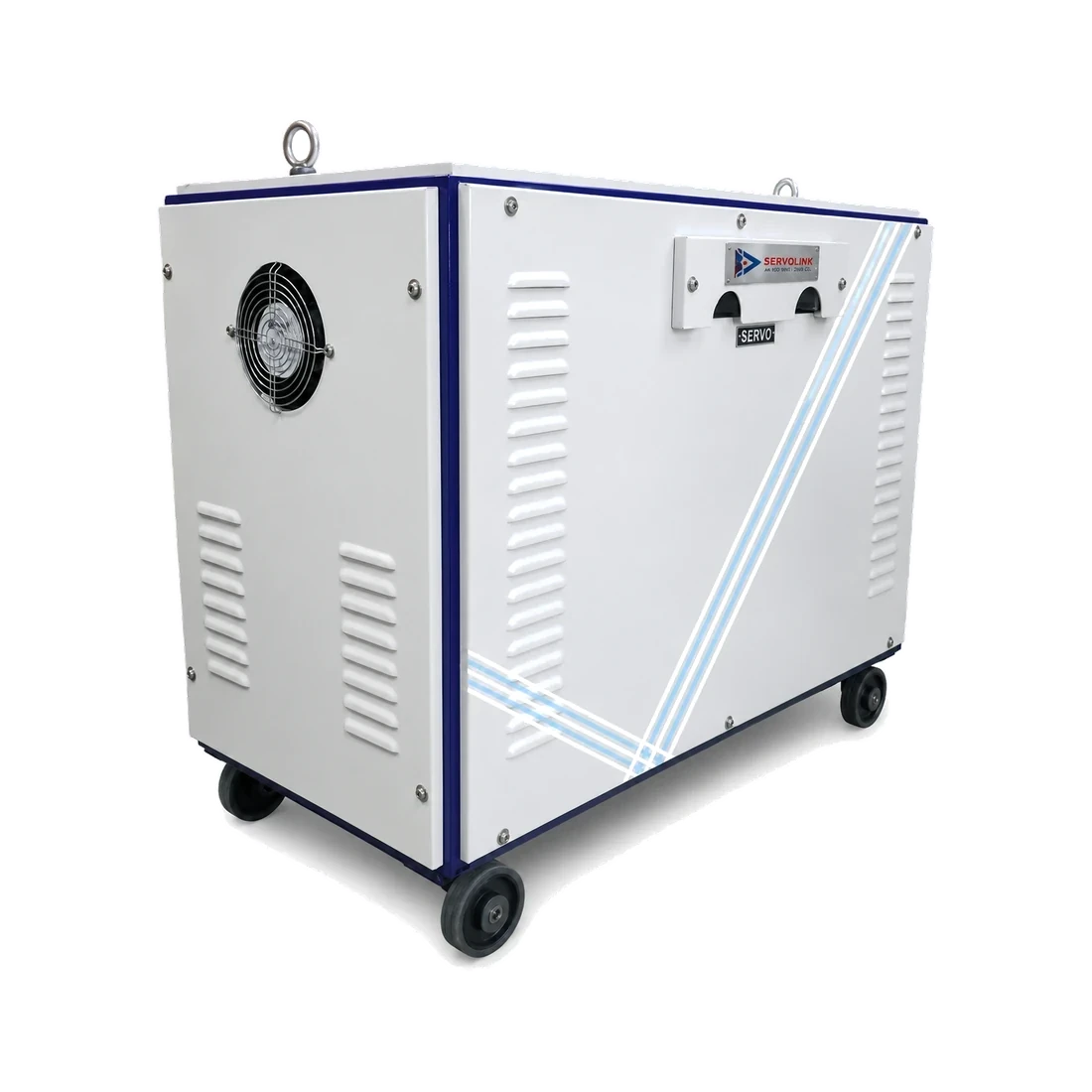
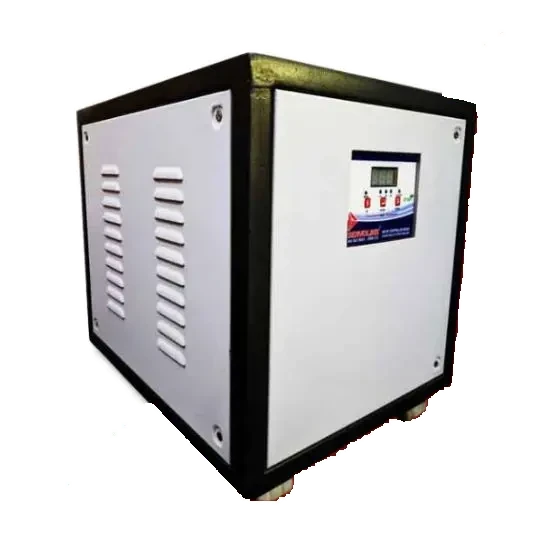
Clean, Isolated Power With No Moving Parts
A Servolink Constant Voltage Transformer (CVT) gives a constant 230 V output that is also isolated from the mains and filtered from spikes and electrical noise.
A servo stabilizer corrects the voltage level. A CVT goes one step further — it also cleans the power. Inside a CVT there is no motor, no carbon brush and no relay, only a specially designed transformer and a capacitor.
The transformer core works in magnetic saturation, so even when the input voltage changes, the output stays nearly constant. Because the input and output windings are separate, spikes, surges and noise on the mains supply do not pass through to the load.
This makes the CVT the right choice for electronic equipment that is sensitive not only to voltage level but also to spikes and noise — CNC controllers, medical equipment, lab instruments, telecom systems, computers and POS terminals.
SERVOLINK makes single phase CVTs from 500 VA to 10,000 VA (0.5 to 10 kVA), copper wound in our own manufacturing facility in Ghaziabad.
CRGO core and copper windings, made in-house and tested before dispatch.

For a motor, the voltage level is what matters. For electronics, the shape and cleanliness of the supply matter just as much. Every factory and building has machines that throw electrical noise back into the line — VFDs, welding sets, induction heaters, switching power supplies and even LED drivers. Every time a big load switches on or off, a short spike travels down the wiring to every other device on the same line.
A CNC controller, a medical monitor or a lab analyser sees this small noise as a false signal. The result is not a burnt card, but something more frustrating: random resets, frozen screens, wrong readings and errors that the service engineer cannot reproduce. A normal stabilizer does not help here, because it corrects the voltage level but passes the noise and spikes straight through.
These loads need a supply that is stable, clean and separated from the mains — which is exactly what a CVT gives.
A CVT is a ferro-resonant transformer. Its secondary winding is connected to a capacitor, and together they form a tuned circuit at 50 Hz. This keeps the secondary side of the core in magnetic saturation. Once the core is saturated, a change in input voltage hardly changes the output voltage — so the output stays steady over a wide input range.
A magnetic shunt between the primary and secondary windings separates the two sides. This is what blocks spikes and noise from the mains and gives the output its isolation.
A CVT is not meant for motor or compressor loads like ACs, pumps, fridges or lifts. These loads draw a very high starting current that a CVT cannot supply. For them, choose a servo stabilizer.
A CVT is also tuned to 50 Hz. When it runs on a DG set whose frequency moves up and down, its output voltage changes with the frequency. For sites on DG supply most of the time, ask our team before choosing a CVT.
| Point | CVT | Servo Stabilizer |
|---|---|---|
| Moving parts | None | Motor, gear and carbon brush |
| Correction speed | Within 1–2 cycles | 20 – 60 V per second |
| Isolation from mains | Yes | No (isolation transformer needed) |
| Spike and noise filtering | Yes | No |
| Motor and compressor loads | Not suitable | Suitable |
| Ratings | 0.5 – 10 kVA | 3 – 2000 kVA |
| Best for | Sensitive electronics, controllers, instruments | Whole buildings, machines, ACs, lifts |
| Brand | SERVOLINK |
| Product Type | Constant Voltage Transformer (ferro-resonant) |
| Capacity | 0.5 - 10 kVA |
| Phase | Single phase |
| Input Voltage Range | 170–270 V or Customized |
| Output Voltage | 220 V (Near to Constant) |
| Frequency | 50 Hz |
| Correction | Instant, no moving parts |
| Isolation | Separate input and output windings |
| Core / Winding | CRGO core, copper winding, made in-house |
| Cooling | Natural / Air Fan for higher Rating |
| Installation | Indoor |
Add the rated VA of all equipment it will feed. Electronic loads with switch-mode power supplies draw a peaky current, so choose a CVT rated well above the total. Share your equipment list with us and we will suggest the right rating.
That is normal. The core of a CVT runs in saturation all the time, so it has some loss and stays warm even when the load is small. Keep it in a ventilated place.
Yes, if the DG frequency stays steady at 50 Hz. If the frequency varies a lot, the CVT output will vary with it.
Very little. There are no brushes or relays. Keep it dust-free, keep the ventilation clear, and get the connections checked once a year.
No. Compressor loads need a stabilizer. Use an AC stabilizer for one AC, or a servo stabilizer for the whole house.
 ISO 9001:20152024–2027
 NSIC Registration2025–2027
 MSME / UdyamRegistered 2021
 Importer–Exporter CodeIssued 2019
 Industrial Registration2010 record
 CE — Certificate of Compliance2015–2016 record
 NSIC–ONICRA Rating2016–2017 rating
 ISO 9001:20152021–2024
 ISO 9001:20152018–2021
 ISO 9001:20082015–2018
 ISO 9001:20082011–2014
Send us your requirements and our team will get back to you with a customized quotation and technical consultation.
★ 4.9
 ★ 4.9
 ★ 4.9
 ★ 4.9