 ★ 4.9
In stock · dispatch in 3–5 days

Built for Heavy Single Phase Load and Long Running Hours
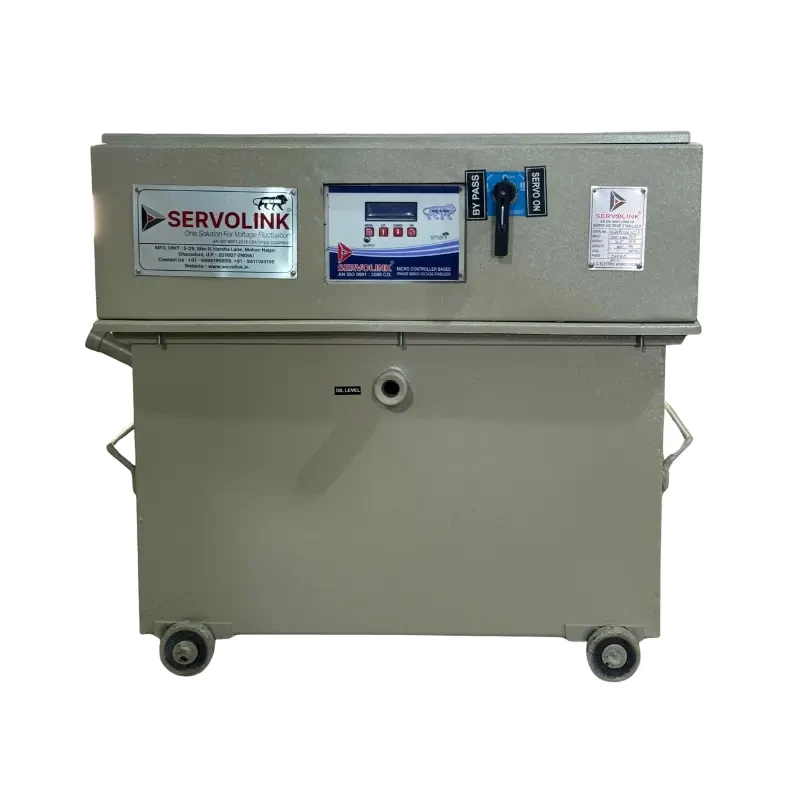
Servolink single phase oil cooled servo stabilizers give a steady 230 V (±1%) output on a heavy single phase load that runs for long hours.
A single phase supply is not always a light load. A workshop with a welding machine and a compressor, a clinic with an X-ray unit, a farmhouse with a submersible pump, or a big house running 4–5 ACs together on a summer night — all of these pull a heavy current on one phase for many hours. An air cooled cabinet gets hot in this duty. In our oil cooled model the buck-boost transformer sits inside a tank filled with transformer oil, and the oil carries the heat out through the tank body, so the stabilizer stays cool even when the load does not stop.
SERVOLINK makes single phase oil cooled servo stabilizers in 10, 15, 20, 25, 30, 40 and 50 kVA ratings, covering input voltage ranges of 100-270 V, 140-270 V and 170-270 V. We also customize as per the customer requirement. The tank is fabricated in our own factory, and the variac and buck-boost windings are 100% copper.
Manufactured by Servolink with strict quality control, guaranteeing exceptional durability and unmatched performance.
The bigger the single phase load, the more it suffers from bad voltage. When the voltage drops, a motor pulls more current to give the same output, so a pump, compressor or AC on low voltage heats up and its winding insulation ages fast. When the voltage shoots up, the control cards and electronics burn first.
Sites with heavy single phase load are usually the ones with the worst voltage — at the end of a long rural line, in a crowded market area, or in a colony where everyone’s AC comes on at the same time at night. On such a site a light-duty stabilizer itself gets overheated. An oil cooled servo stabilizer is made for exactly this: heavy load, long hours and poor supply, all together.
If your load runs for long hours or your site is hot and dusty, then the oil cooled model is the right choice for you. The transformer oil keeps the windings cool even when the stabilizer is running near its full load all day — like in summer, when the AC, pump and fridge are all running together for long hours. That is why oil cooled stabilizers are most commonly used in workshops, small factories and sites where the single phase load is heavy.
Main USPsIn the oil cooled model the correction works the same way as every Servolink servo, only the cooling is different. The control card compares the output with the set 230 V. If it is low, the servo motor turns forward and moves the carbon brush up the copper variac track; if it is high, the motor reverses. The buck-boost transformer, sitting in oil inside the tank, then adds or subtracts that voltage from the line. Follow the numbers in the diagram below.

Tap the diagram to open it full size
| Brand | SERVOLINK |
| Product Type | Single Phase Oil Cooled Servo Voltage Stabilizer |
| Capacity | 10, 15, 20, 25, 30, 40 & 50 kVA; other ratings on request |
| Supply System | Single phase, phase + neutral, with protective earth |
| Input Voltage Range | 100-270 V / 140-270 V / 170-270 V, or customized |
| Output Voltage | 230 V ±1%, within the specified input range and rated load |
| Frequency | 50 Hz |
| Mode of Operation | Automatic, servo-controlled |
| Duty Cycle | Continuous operation within rated conditions |
| Efficiency | More than 98% |
| Variac | 100% copper wound, made in-house |
| Cooling | Oil-cooled, buck-boost transformer immersed in transformer oil |
| Oil Level Indicator | Provided on the tank |
| Installation | Indoor and outdoor (under shed) |
| Ambient Operating Temperature | Up to 50°C |
| Display | LCD display panel on all models |
| Voltage Protection | High/low voltage cut-off on all models |
| Overload / Short-Circuit Protection | As per selected model |
| Restart Delay | Provided on all models |
| Manual Bypass | Optional |
| Mobility | Iron wheels provided |
| Standard | Built as per IS 9815 (Part 1):1994, IS 5142, IS 302 (Part 1) |
Because the buck-boost transformer and its windings are dipped in transformer oil inside a closed tank. When the stabilizer runs, the windings get hot, and the oil takes this heat and passes it out through the tank body. This keeps the stabilizer cool even on heavy load. At SERVOLINK the tank is fabricated in our own factory and the windings inside are 100% copper, so the heat transfer to the oil is better.
Transformer oil is used. It cools the windings and also works as insulation between them. Never fill engine oil, hydraulic oil or any other oil in the tank, because it can damage the insulation and the stabilizer.
Every oil cooled unit has an oil level indicator on the tank, clearly marked as OIL LEVEL. Check it when the stabilizer is switched off and cool. If the level is below the mark, get it topped up with transformer oil by a technician.
The windings are not fully covered with oil, so the heat is not removed properly. The stabilizer starts getting overheated, and the winding insulation can get damaged. If you see a low oil level, switch off the unit and get it topped up first.
There is no fixed time. If the tank stays sealed, the same oil works for many years. Get the oil tested once a year (colour and BDV test), and change it if it has turned dark, has moisture or sludge, or fails the test. At hot and dusty sites, check it more often. Under our AMC, our technician does the oil check and testing at your site.
Oil turns dark because of overheating, moisture or ageing. Dark oil or oil with a burnt smell means the stabilizer was running hot or the oil has gone bad. Get it tested and replaced, and check that the stabilizer is not overloaded.
Do not keep running the stabilizer with a leak. Leakage normally comes from the gasket, drain plug or terminal points. Switch it off, clean the area and call our service team. Since we make our tanks in-house, we can replace the gasket or repair the tank ourselves without waiting for an outside vendor.
No. We supply a separate barrel of transformer oil with the stabilizer. Our technician fills it at the time of installation — please do not fill it yourself or use any other oil.
In a ventilated room or under a shed, on a strong, level floor, away from heaters and anything that can catch fire. Keep some space around the tank for air and service. Oil cooled units are heavier than air cooled ones, so they come with iron wheels. The tank and body must be connected to a proper earth.
Add the load of all the equipment that can run together, including pumps, ACs and motors. Then choose a rating so that your normal running load stays around 60–70% of the stabilizer rating. This gives margin for motor starting and keeps the stabilizer cool. Share your load list with us, or use our kVA calculator.
It is a little costlier because of the oil tank and the transformer oil. But for heavy loads and long running hours it runs cooler and lasts longer, so it gives better value in the long run. And since we make the variac, buck-boost winding and tank in our own factory, there is no middleman cost in our price.
We have been making stabilizers since 1980. Every part of our servo is made in-house at our 16,000 sq ft factory in Ghaziabad: variac winding, variac motorization, buck-boost winding, tank fabrication, assembly and testing, each in its own workstation. Our variacs are 100% copper wound, our servos are built as per IS 9815, and every unit is tested in our own testing section before dispatch.
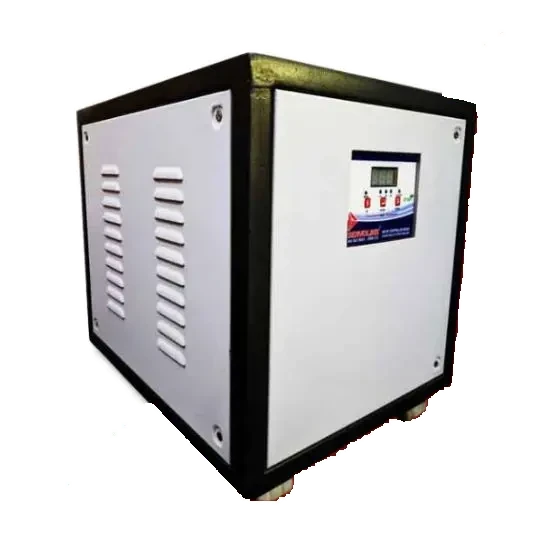
For indoor homes, shops and offices with moderate loads, our single phase air cooled stabilizers may be a better fit.
 ISO 9001:20152024–2027
 NSIC Registration2025–2027
 MSME / UdyamRegistered 2021
 Importer–Exporter CodeIssued 2019
 Industrial Registration2010 record
 CE — Certificate of Compliance2015–2016 record
 NSIC–ONICRA Rating2016–2017 rating
 ISO 9001:20152021–2024
 ISO 9001:20152018–2021
 ISO 9001:20082015–2018
 ISO 9001:20082011–2014
Send us your requirements and our team will get back to you with a customized quotation and technical consultation.
★ 4.9
 ★ 4.9
 ★ 4.9
 ★ 4.9