 ★ 4.9
In stock · dispatch in 3–5 days

Maintain Consistent Power Across Your Operations
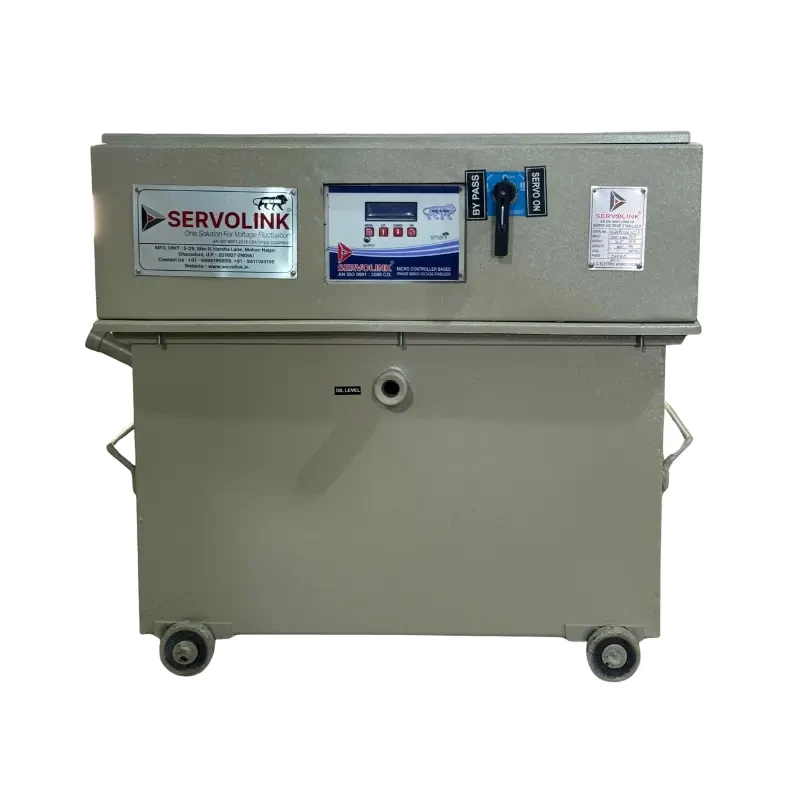
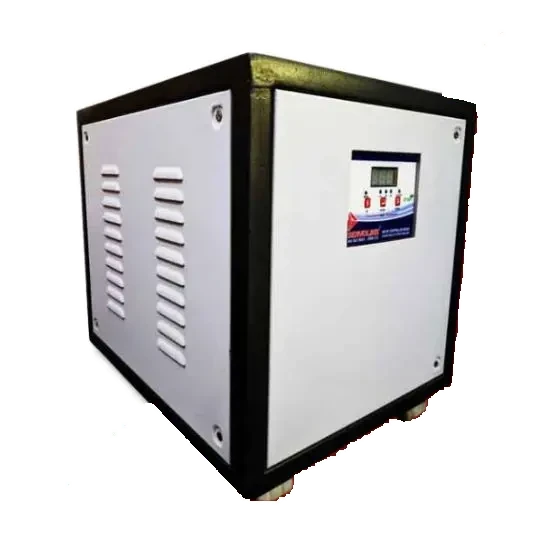
A three phase air cooled servo stabilizer monitors all three phases at the same time instead of just one, and ensures that all three phases hold a 415 V steady supply.
Your machines get the same correct voltage on all three phases R, Y and B at the same time, even when the grid does not give it. SERVOLINK builds them from 6 kVA to 100 kVA in our own manufacturing unit, with the output kept within a variation of ±1% of 415 V between phases (230 V between phase and neutral), and without a single drop of transformer oil inside.
In a three phase supply, the three phases rarely go up and down at the same time. One phase can be low while the other two are normal — in a factory when a big motor starts, or in a building where most of the single phase load sits on one phase. Our servo stabilizer observes each phase on its own, and a slight variation triggers the servo motor of that particular phase to adjust its carbon brush position in the variac, while the other two phases are left untouched.
SERVOLINK makes three phase air cooled servo stabilizers in 3/6, 10, 15, 20, 25, 30, 40, 50, 60 and 100 kVA ratings, covering wide to normal working input voltage ranges from 240-470 V, 300-470 V and 340-470 V. Each phase has its own 100% copper wound variac and buck-boost transformer, both wound in our own factory.
Designed and produced by Servolink, ensuring superior quality, unwavering reliability, and optimal efficiency.
In India, factories and commercial buildings get three phase supply, but the voltage on the three phases is rarely equal. The grid voltage keeps changing during the day, and the load on each phase is also different. If most of the ACs, lights and single phase machines in a building are on one phase, that phase drops while the others stay high — very common on summer afternoons in office buildings, and in industrial areas at shift change when many machines start together.
Unbalanced and unstable voltage is very harmful for three phase machines. For a three phase motor, a voltage difference of just 2% between phases can push the winding current up by 12 to 20%, so one winding keeps heating more than the other two. CNC drives and PLCs trip or show errors, lifts stop between floors, chiller compressors fail, and control cards get damaged. This leads to breakdowns, production loss and costly repairs.
If your building has a three phase supply, then a three phase servo stabilizer is what you need. Factories, workshops, hospitals, banks, offices, gyms, hotels, schools and big houses with a three phase connection all come in this category. Machines like CNC, lifts, chillers, central AC plants, printing machines, air compressors and lab equipment run on three phase, and they are very sensitive to voltage changes.
Why choose an air cooled model? The air cooled design is compact, easy to move and install, and does not need transformer oil. If your load is up to 100 kVA and the stabilizer is placed in a clean, covered electrical room with proper ventilation, the air cooled model is the right choice for you. There is no oil to check or change, and the unit can be placed close to the machine or the main panel.
Main USPsR, Y and B each have their own variac, buck-boost transformer and servo motor. The control card reads the input and output of every phase, and runs that phase’s motor forward or in reverse to move its carbon brush along the variac. The buck-boost winding then adds or subtracts exactly the correction needed. Follow the numbers in the diagram below.

Tap the diagram to open it full size
| Brand | SERVOLINK |
| Product Type | Three Phase Air-Cooled Servo Voltage Stabilizer |
| Capacity | 3/6, 10, 15, 20, 25, 30, 40, 50, 60 & 100 kVA; other ratings on request |
| Supply System | Three phase, 4 wire (R, Y, B + neutral), with protective earth |
| Input Voltage Range | 240-470 V / 300-470 V / 340-470 V (phase to phase), as per selected model |
| Output Voltage | 415 V ±1% phase to phase (230 V ±1% phase to neutral) |
| Frequency | 50 Hz |
| Control Type | Independent phase control (unbalanced type), each phase corrected separately |
| Mode of Operation | Automatic, servo-controlled |
| Duty Cycle | Continuous operation within rated conditions |
| Efficiency | More than 98% |
| Variac | 100% copper wound, made in-house |
| Cooling | Air-cooled (natural air, fan on higher ratings) |
| Installation | Indoor |
| Ambient Operating Temperature | Up to 50°C |
| Display | LCD display panel on all models |
| Voltage Protection | High/low voltage cut-off on all models |
| Phase Protection | Single phasing and phase reversal protection |
| Overload / Short-Circuit Protection | As per selected model |
| Restart Delay | Provided on all models |
| Switchgear | Lauritz Knudsen (L&T) MCB and MNX contactors |
| Bypass | Heavy duty rotary cam bypass switch (on request) |
| Mobility | Iron wheels provided |
| Standard | Built as per IS 9815 (Part 1):1994, IS 5142, IS 302 (Part 1) |
415 V (±1%) between any two phases, and 230 V (±1%) between any phase and neutral. Both are the same supply, just measured in two ways. Your three phase machines use 415 V, and the single phase appliances in the building use 230 V.
A balanced type has one motor driving all three variacs together, so it corrects all three phases by the same amount. It works only if all three phases go up and down together. An unbalanced type has a separate variac, motor and control card for each phase, so each phase is corrected on its own. In India the supply is mostly unbalanced, so the unbalanced type is the safer choice — SERVOLINK three phase stabilizers are unbalanced type.
Yes. One three phase servo stabilizer on the main incoming supply protects all three phases of the building, so every room and every appliance gets stable voltage. A single phase stabilizer on one phase protects only that one phase.
One three phase stabilizer is better for most buildings. It is one unit with one bypass and less wiring, and it can run three phase machines like lifts, pumps and chillers. Three single phase stabilizers can only feed single phase loads, and they cannot run a three phase motor properly.
A three phase motor running on only two phases gets overheated within minutes and can burn. Our single phasing protection disconnects the output as soon as any phase fails, and reconnects automatically when all three phases come back.
This is called neutral failure, and it is very dangerous for single phase appliances. The voltage on the lightly loaded phase can shoot up towards 415 V, and appliances on that phase can burn. The high voltage cut-off disconnects the output to protect your equipment. Always keep the neutral connection tight, and get it checked if lights suddenly start glowing very bright or very dim.
Add the kW of all three phase and single phase loads that can run together, and divide it by the power factor (take 0.8 if you don’t know it) to get kVA. Then choose a rating so that this running load stays around 60–70% of the stabilizer rating. For example, a 24 kW load is 30 kVA, and at 60–70% loading it needs a 50 kVA stabilizer. This margin takes care of motor starting and keeps the stabilizer cool. Share your load list with us, or use our kVA calculator, and we will suggest the right kVA.
It means the stabilizer gives a stable 415 V output as long as the phase to phase input stays between 340 V and 470 V. If the input goes outside this range, the cut-off disconnects the output. For areas with very low voltage (end of a long line, rural areas or crowded industrial areas), choose a wider range like 240-470 V. A wider range needs a bigger buck-boost transformer, so select the range that matches your site.
Yes. These are the machines that need stable voltage the most. Tell us the kW rating and the starting current of the machine, because lifts and chillers draw a high current at start, and the stabilizer must be sized for it.
The bypass switch lets you run the load directly from the mains when the stabilizer needs service or has a fault, so your work does not stop. Operate it only as shown in the user manual, and switch the stabilizer back in once the service is done, because in bypass your equipment gets the raw grid voltage.
The input side shows the actual grid voltage of each phase, and that is normally different on each phase. The output side should show nearly the same voltage on all three phases. If the output voltages are very different from each other, the stabilizer needs service.
Yes. Connect it after the changeover switch, so it gets both the grid supply and the DG supply. DG voltage also changes with load, and the stabilizer keeps it steady. The restart delay gives the DG time to settle before the output switches on.
Choose oil cooled if your load is above 100 kVA, if the load runs near full rating all day, or if the site is hot, dusty or outdoor. We make three phase oil cooled servo stabilizers up to 2000 kVA.
We have been making stabilizers since 1980. Every part of our servo is made in-house at our 16,000 sq ft factory in Ghaziabad — variac winding, variac motorization, buck-boost winding, enclosure fabrication, assembly and testing, each in its own workstation. Our variacs are 100% copper wound, our servos are built as per IS 9815, and every unit is tested in our own testing section before dispatch.
We have over 4 decades of experience in the industry, making us a trusted and reliable company with a long history of success.
Our products and services meet the highest global standards, ensuring you receive top-notch quality.
We provide service and delivery across 22+ states.
We have international clientele in over 7 countries, demonstrating our experience working with a diverse range of customers.
Our dedicated customer support team is available to assist you, even if you're an international client.
We offer affordable and competitive pricing, ensuring you get good value for your money.
 ISO 9001:20152024–2027
 NSIC Registration2025–2027
 MSME / UdyamRegistered 2021
 Importer–Exporter CodeIssued 2019
 Industrial Registration2010 record
 CE — Certificate of Compliance2015–2016 record
 NSIC–ONICRA Rating2016–2017 rating
 ISO 9001:20152021–2024
 ISO 9001:20152018–2021
 ISO 9001:20082015–2018
 ISO 9001:20082011–2014
Send us your requirements and our team will get back to you with a customized quotation and technical consultation.
★ 4.9
 ★ 4.9
 ★ 4.9
 ★ 4.9